

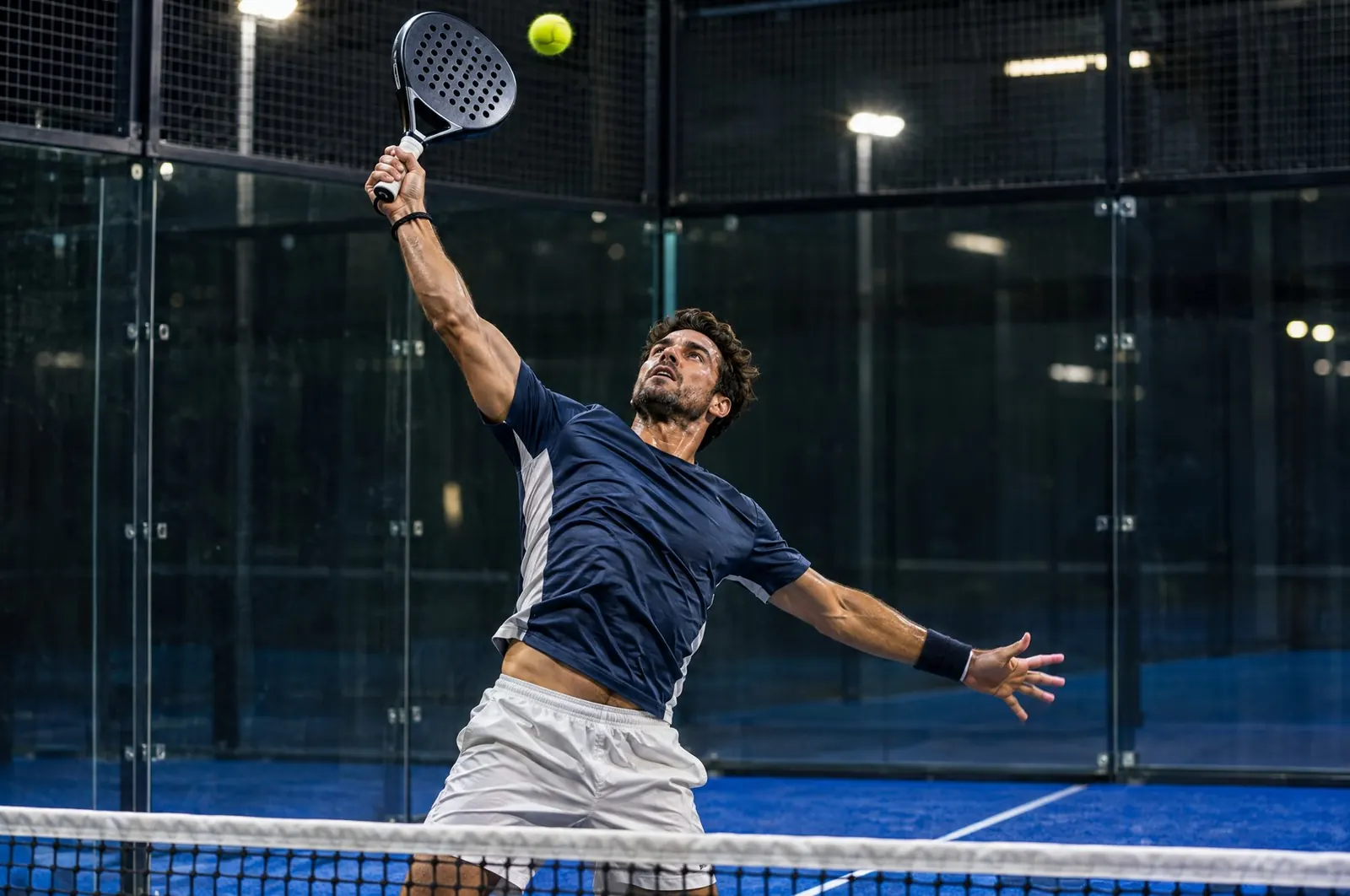
Use a continental grip, the same grip you use for volleys and the serve. Many players turn it slightly further towards the backhand side, so the racket face brushes up and across the ball and adds the topspin that makes it kick high off the back glass. Hold it loosely, at around three or four out of ten, so your wrist can snap through.
What is a kick smash?
A kick smash is an overhead where you put heavy topspin on the ball so it bounces steeply and kicks high off your opponents' back glass. Hit hard enough, it can bounce out over the glass or the side fence for a winner. It is different from a flat smash, which goes for pure speed, and from the vibora and bandeja, which are controlled overheads that keep the ball low.
The basic grip: continental
The continental grip is the starting point for almost every overhead in padel. To find it:
- Hold the racket on its edge, as if you were going to chop with it.
- Shake hands with the handle, so the V between your thumb and first finger sits on the top edge of the grip.
- The racket face should look like a natural extension of your palm turned slightly outwards.
Because you already use this grip for volleys and the serve, you do not need to change grip at the net when a lob comes over. That saves a vital split second.
Adjusting it for more kick
To add topspin, many players turn the hand a little further round the handle, towards an eastern backhand position. This closes the racket face slightly at contact, so instead of hitting flat through the ball you brush up and across it. The result is more spin, a higher bounce and more chance of the ball leaving the court.
Go gradually. Turn too far and you lose power and control. A small adjustment, often only a few millimetres on the handle, is enough for most club players.
Grip pressure matters as much as grip position
A tight grip locks your wrist and kills the whip that creates spin. Keep the grip loose through the swing and let the racket accelerate at the top. Our guide to how tightly to grip a padel racket explains the scale, and both of our wrist pronation guides, what is wrist pronation and how best to use it, show how the forearm turns through contact.
Common mistakes
- Using a forehand grip. A semi-western grip from tennis makes it very hard to brush up the back of the ball overhead.
- Hitting from too far behind. The kick smash works best near the net with the ball in front of you. Further back, play a bandeja or vibora.
- Trying to hit too hard. Spin, not raw speed, makes the ball kick. See how fast a padel ball goes for why speed alone rarely wins the point.
When not to go for it
If your opponents are ready at the back, or the lob is deep, a failed kick smash leaves you exposed. A controlled overhead or a bajada off the back glass is often the smarter shot.
The bottom line
Start with a continental grip, turn it slightly towards the backhand for more spin, keep it loose and brush up across the ball. Save the kick smash for short lobs near the net.
Related questions
Is the kick smash the same as the por tres?
The por tres is a kick smash hit hard enough to bounce out over the side fence. Every por tres is a kick smash, but not every kick smash leaves the court.
Should beginners try the kick smash?
Learn the bandeja first. It teaches the continental grip and overhead timing that the kick smash builds on.
Do I need a special racket for the kick smash?
No. A rough surface can add a little spin, but technique and grip matter far more than the racket.