

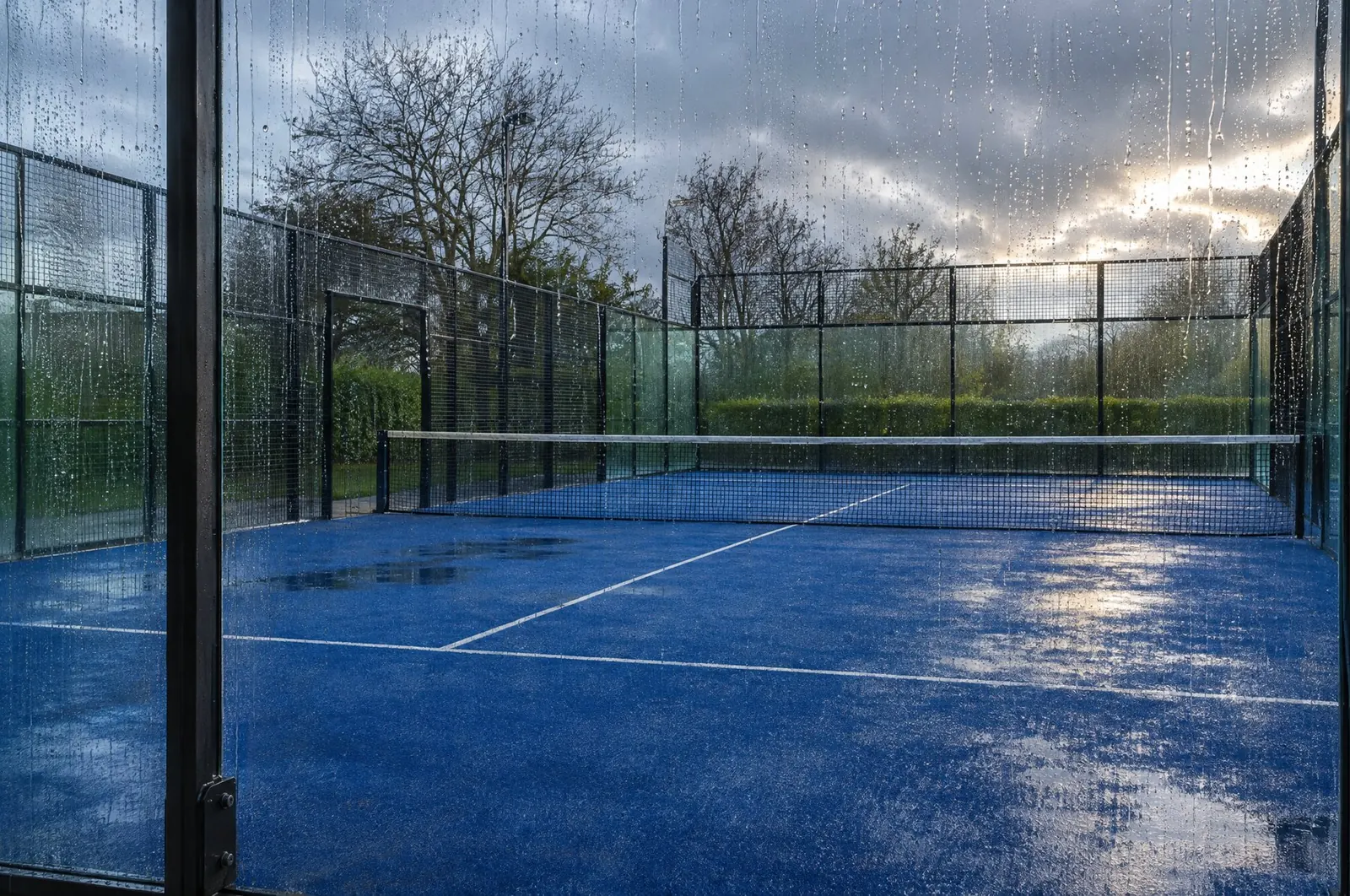
A well-maintained outdoor padel court drains quickly, and after light rain the turf is often playable within roughly 15 to 30 minutes of the rain stopping. Older courts with compacted sand, heavy rain and cold weather can make it take much longer. The glass walls usually stay wet for longer than the floor, so test the surface and the walls before you play.
Why padel courts drain quickly
Most outdoor padel courts are laid with artificial turf on a permeable base, with sand infill between the fibres. Rain soaks down through the turf instead of sitting on top, which is why a court can look playable soon after a shower. That only works if the drainage is kept clean and the sand is maintained. Compacted sand, blocked drainage or worn turf can leave water sitting on the surface for hours.
What affects drying time
- How much rain fell. A short shower clears far faster than a morning of steady rain.
- The condition of the court. Newer, well-brushed courts drain best. Patches where water pools are a sign of compacted sand or drainage problems.
- Temperature and wind. In a UK winter, with low sun and little wind, courts and glass dry slowly.
- Shade. Courts surrounded by trees or buildings can stay damp for much longer.
- Roofs and canopies. Covered outdoor courts stay largely dry, although wind-blown rain can still dampen the edges.
The glass dries last
Even when the turf looks fine, the glass walls are often still wet. A wet ball skids off wet glass instead of rebounding normally, which changes the game and can catch you out when you are running towards a wall. Wipe the glass with a towel or squeegee if your club allows it, and give the court a few extra minutes.
How to tell if a court is ready
- Look for standing water. Any puddles mean the court is not ready.
- Press a towel into the turf near the service line. If it comes up wet, wait.
- Test your footing. Plant a foot and turn. If your shoe slips, the court is not safe yet.
- Bounce a ball off the back glass. If it skids low, the walls need more time.
- Follow your club's rules. Many clubs close outdoor courts in heavy rain for safety and to protect the surface.
Look after your balls and racket
Balls that get wet become heavier and play differently, so keep a dry tube for when the rain has stopped. Dry your racket and grip with a towel after playing in damp conditions and do not leave it in a wet bag. Our guide to when to change your racket covers the signs of wear to look for.
Indoor courts are the safe option
If rain is forecast, an indoor court avoids the problem completely. Our guide to padel courts in the UK can help you find one.
Indoor courts avoid the rain but bring their own quirks, such as what happens if the ball hits the roof.
The bottom line
After light rain, a well-drained court can be playable within about half an hour. Check for puddles, test your footing and the glass, and never play on a slippery surface.
Related questions
Can you play padel on a wet court?
Only if there is no standing water and your footing is secure. Wet turf and wet glass increase the risk of slipping and change how the ball bounces.
Do padel clubs refund bookings for rain?
Policies vary between clubs. Check the booking terms, as some offer credit or rebooking when outdoor courts are closed for weather.
Does rain damage padel balls?
Wet balls absorb water, become heavier and play differently. Use a dry tube once the rain has stopped.